[simpleviewer id=78 width=”700″ height=”600″]

Previous Room                                                                                              Next Room 

RETURN TO MAP

Johnny takes hold from Dalton Trumbo novel Johnny got his gun (1939), from the homonymous movie directed by the novel’s autor himself in 1971 and from the piece inspired by it One, recorded by Metallica in their album …And justice for all, and it merges the three languages of literature, music and movies in one single multimedia work, with real actors made of paper and light, made with nothing, like Testori theatre of Gli Scarozzanti.
Johnny’s story is simple and terrible: a young american, in the end of the first world war is been sent at the european front where, shot by a grenade, he loses his legs, his arms, his face, his ears and all of his senses but the touch. Considering his state, he is believed incapable of discernment, and he is artificially kept alive year after year just for scientifical reasons, in a small bed in a dark closet. Actually, even if he is unable to communicate, his mind is perfectly awake and aware of the terrible situation, and his thoughts, his fears and his hopes – vain – over the years cross that obscure boundary between life and death, making him unaccepted, the only dead among the alive, the only alive among the dead. I’ve always considered this story as fundamental to me. Certainly because since I was young my family events led me to have a daily realtionship with the deasese. And certainly because I think it could be so extreme, and so unbeareble and so terribly true. Johnny extends his death almost endlessly, living and living again thousands of times the transition from life to death, that passage that none of us could know, the one that in Trumbo’s movie nobody, not even Christ, could understand or just stand. In this frame Johnny seems to me like a Christ armless and legless, who can’t be given not even of a cross – necessary croassroad to the redemption – and thus who can’t be given of salvation.
The only relief he can find is around a sweet nurse next to his bedside, to carry him in his endless transition. While I was reading again an interview to Lucia, Testori’s sister, I noticed how necessary was, in this house, to carry oneself beloved towards the afterlife.
Testori used to sleep in that bed where his parents passed away, keeping physically alive the flame of their presence. Parents who, right here, in this room where the living/dying Johnny rests in his hospital bed, were presented for the last time to the love of their dear ones. “Now the world is gone, I’m just one”.
[simpleviewer id=77 width=”700″ height=”600″]

Previous Room                                                                                         Next Room 

RETURN TO MAP

While I am walking with Julia through the rooms of Casa Testori, during the first inspection for the exhibition, we find ourselves in the big hall, the biggest room of the house. I check the measures, i make a couple of calculations and I realize that, right there, Johnny is perfectly fitting. So I try to lower the shutters to estimate the darkness’ degree of the room, thinking of the video-projection.
As I’m lowering them, I notice a particular drawing created by the extierior light between the holes in the shutter itself. I ask Pietro, who’s right there, what is that, and he explains me that it’s the shadow of the decorated bars in front of  the windows. I turn around looking at the three big windows of the apsidal porch, and I immediately picture me plugging some of the shutters’ holes with scotch tape.
The principle is easy; is the chinese shadow’s one, the principle of the end of 18 century’s theatre: a shape and a back-projected light.
Inquiring about the several room’s function, I find out that was exactly in the porch where the beloved deads’ bodies where brought to the last goodbye: so, on these three big shutters, I portray a Christ’s Deposition and Transport, using as the three crosses, the central wooden axis of the french door and putting in open dialogue this work with the opposite Velazquez’s Crucifixion reported and divided in Johnny’s video-installation.
The semantic link between these two works is also enhanced by the itself experience of Johnny the soldier who – as represented down on the right in the installation – is shot and mutileted by a granade while carrying a dead body toward the trench.
The ironical title of this work, Easy come, easy go (that it’s actually the title of the whole exhibition), underlines the precariousness of the human condition and even of the divine one, both by representing the empty cross and by the utilized technical support (the half-lowered shutter): as the Saviour arrives, he’s already gone.

[simpleviewer id=73 width=”700″ height=”600″]

Previous Room                                                                                          Next Room 

RETURN TO MAP

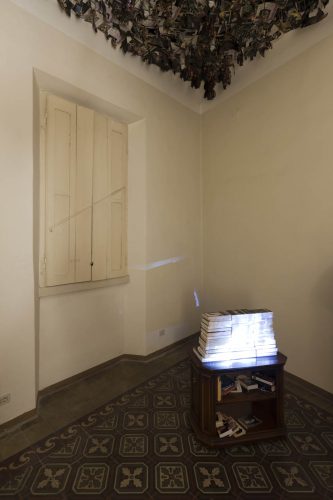
Dracula has been accomplished for the first time in 2008 at Nickelodeon’s exibition at Milano’s 1000events: Bram Stoker’s Dracula is among the novels which have had the biggest number of film adaptations, we can count approximately 650 out of it. In this work I show the video-screening of eight movies based on transylvanian Count’s history (from 1922 Murnau’s Nosferatu to Herzog one, up to Coppola Bram Stoker’s Dracula, touching 1931 Tod Browning Universal’s versions and 1958 Terence Fisher’s Hammer) made on book backs of about 60 different editions of the novel itself. This work, besides emphasizing the unavoidable differences of interpretation both at a direction level and at a novel translation one, takes hold from the copyright’s concept about the transposition of any given literary work towards film: indeed Nosferatu has been the first acknowledged case of plagiarism made by a director against a novel. Even if Murnau changed the title and the names of the characters, he entirely resumed Stoker’s book plot. The writer’s widow sued the director for plagiarism and she won, forcing the director to destroy the movie. Just by chance a couple of copies has been rescued, allowing us to still admire this masterpiece. This case created a judicial precedent and since then the copyright was enlarged to any film transposition of literary works, too.

On the ceiling, Dracula is completed by Chirotteri’s installation, approximately 200 books about bats, cut and fixed with screws side by side. This work clearly takes hold from Enciclopedia dei fiori da giardino and was born in a 2009 October’s night: I was in New York and I was actualizing, with my assistants, the Non ci resta che piangere ship, the installation for the Museum of Art ahd Design. In the night, after having worked for 12/14 hours, I often walked by Strand Books, this huge bookshop beetween 12th street and the Broadway, where every time i used to look for new ideas for new works, and so I ran into this amazing volum exclusively about bats, the kind of stuff I’ve never seen in Italy. Immediately started the idea of covering a whole ceiling with books of that genre. That was the primitive core of The Island of Dr. Mastrovito’s installation at Governors Island in 2010, that besides the bats on the ceiling, it contemplated hundreds of books about butterflies on walls and volums about every animal’s species – life-size represented – on the floor.
This room, exactely located where was one of Testori’s libraries, close the cycle of the three rooms books dedicated, room that Testori himself dedicated to books’ and works’ study.

[simpleviewer id=76 width=”700″ height=”600″]

Previous Room                                                                                          Next Room 

RETURN TO MAP

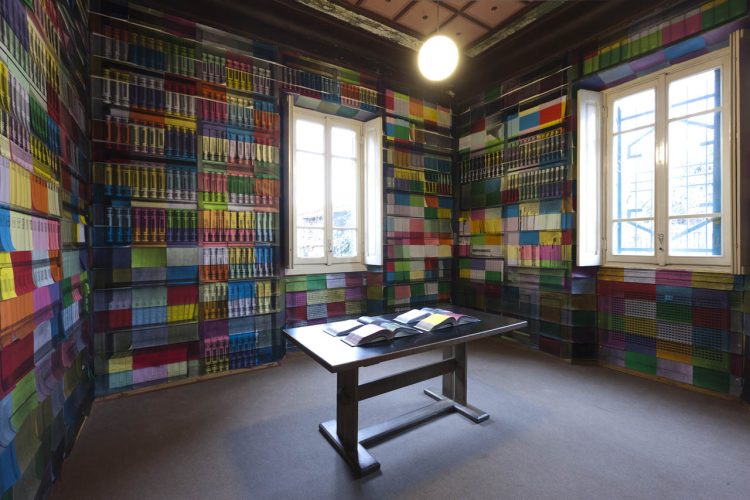
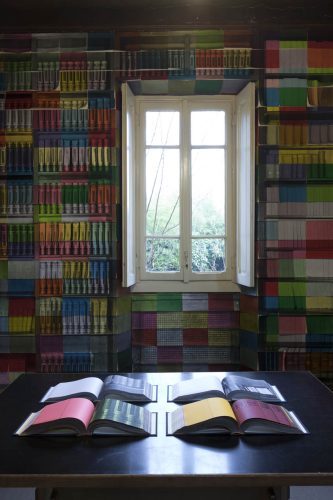
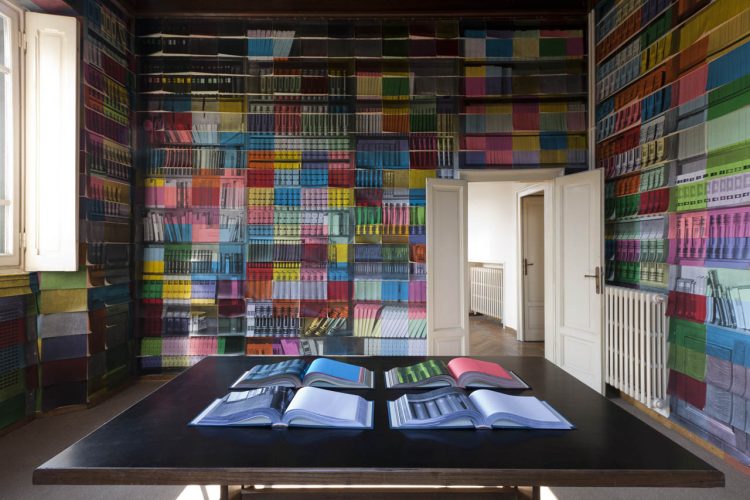
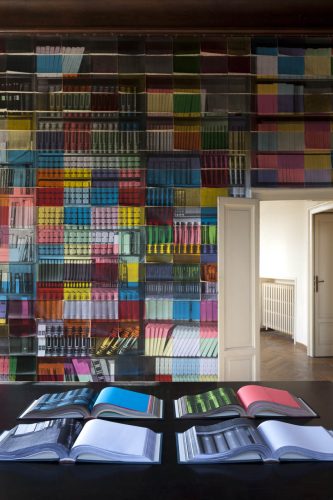
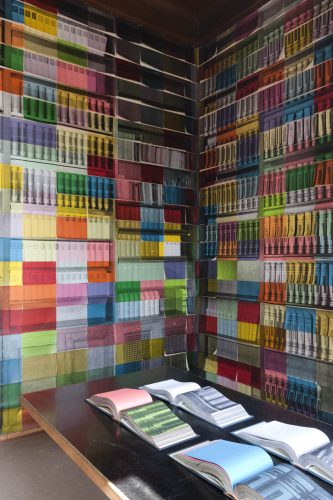
In my work I’ve often resorted to photocopy. After I had photocopied the whole Analix Forever gallery in 2007, the very next year I found myself in New York, at the Italian Academy at Columbia University. They had in here a wonderful (aesthetically) library, huge, warm, comfortable: it invited you to lie down on big couches and read books all day long, if only all the volumes weren’t disposed randomly and an index or a catalogation weren’t missing. All that because, as it seems, the whole Italian Academy’s big books collection was been sold (I think to the Columbia) and the italian Government had thought only after many years to send tens of boxes containing thousands of loose books, from the litterature ones to the art history ones. Disposed like that, the volumes looked actually beautiful and new (some of them were still wrapped up, but they were basically unusable. I’ve been really impressed by the concept of “frontside”, were the book became a piece of furnishing (the fact that the libraries of the Academy were empty, back in time, it had sicken several Columbia’s professors, that notice them while taking a walk on the Amsterdam Avenue), and because of that I decided to create by myself the books index, just by photocopying the whole library, volum after volum, and re-installing the photocopies on the actual books. In the meantime, to facilitate the usage of the new photocopied library, I binded two different copies of all the approximately 1360 images used in two big catalogues of two volumes each. The metonymy as far achieved, the container for the content (the library INSIDE the books), allowed the visitator to leaf quickly through every back of the library’s books and find thus, in an easier way, the wanted volum.
The idea of rebuilding this “travelling” library at Casa Testori starts from here: the original images’ files are been readapted to the measures of the room that was Giovanni Testori and his nephews’ studio, and these files cover now the walls simulating  the presence of books and shelves. The fact that this library is, for its own nature and from the beginning, easy come, easy go, makes it especially suitable to the walls of Casa Testori, where Giovanni used to have his real library, or his collection’s pictures that, after having been studied and eviscerated, they were straightaway replaced with new paintings by different authors.

[simpleviewer id=84 width=”700″ height=”600″]

Previous Room                                                                                              Next Room 

RETURN TO MAP

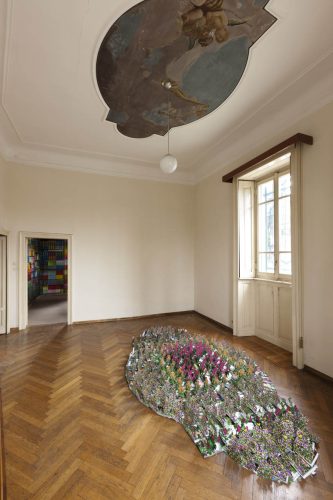
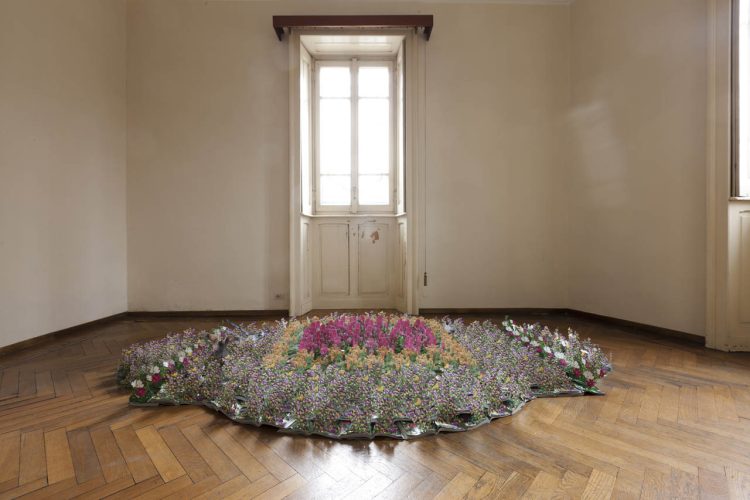
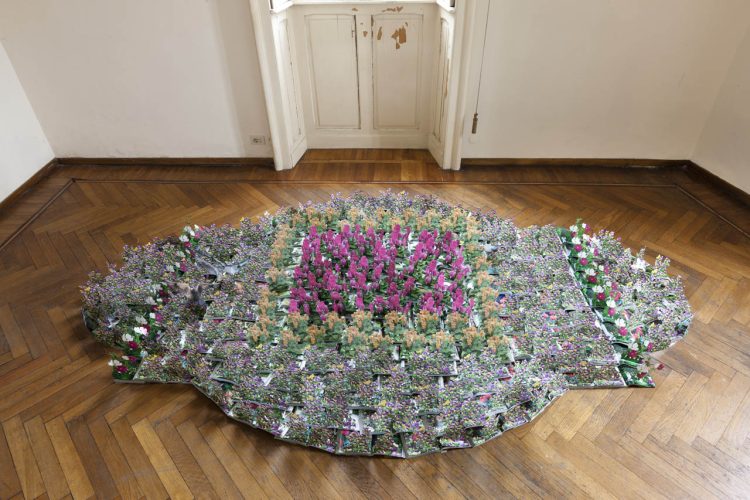
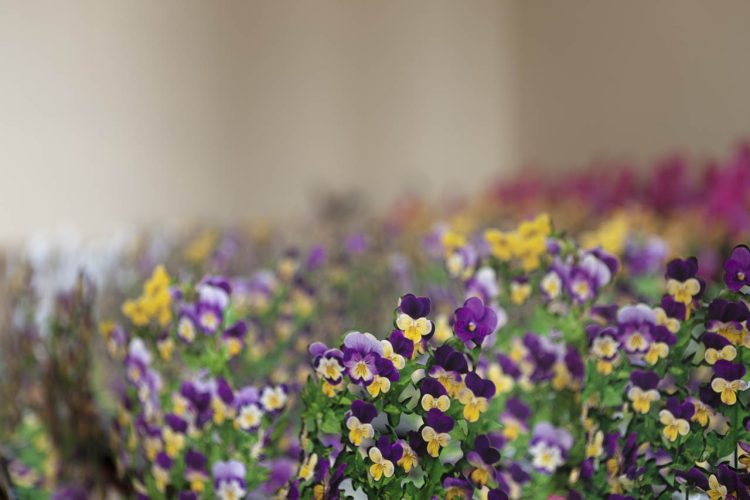
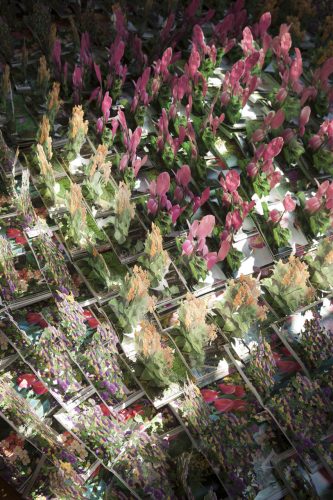
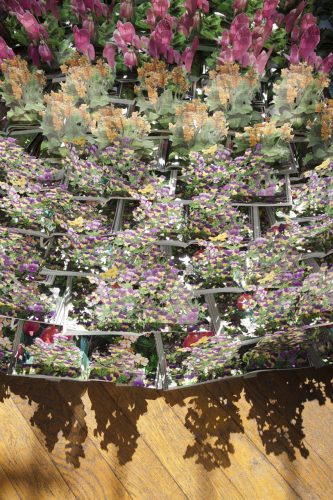
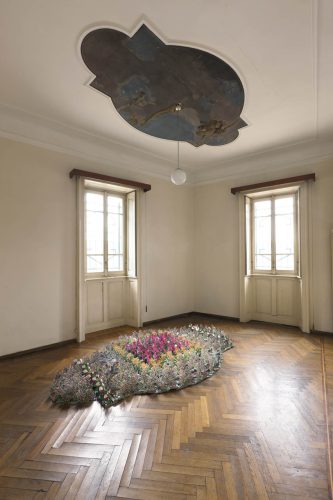
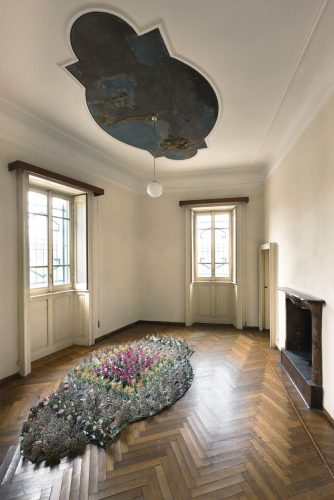
I got the idea of these “gardens of books” in a two years ago evening, while I was arranging the studio. Zizi, my fraternal brother, came to ask me to make, at once, necessarily, a little work for a girl he had to seduce, a dancer. So, after an ungentle discussion, to make it fast, I decided to take one of the Degas’ books I had on my shelves. I open the book on a riproduction of two ballerinas and I cut them on three of their four sides, letting them attacked to the page by their feet. Once they were bent perpendicular to the page, seen from the side, they seem actually dancing on the book. Zizi grabbed the volum, he gave it to the dancer, and thanks to the power of Art, they are now living together in a nice house next to the Serio river. Reaching the Enciclopedia dei fiori da giardino was an easy step from there: I noticed the naturalness and the immediacy of that work, but I needed something to give it strenght and verity. So I thought of flowers: strenght, because from the flower arises the fruit, from the fruit the tree, from the tree the paper and from the paper the book, that in my work was coming back as a flower, closing the circle going back to the starting point of the cycle. Verity because flowers on handbooks are usually in 1:1 scale, in their real dimensions, thus likely to see. In Casa Testori I show this flowerbed reproducing the exact shape of the trompe l’oeil painted on the ceiling above, becoming itslef a trompe l’oeil. Specular to the fresco also in the placement of the doves between flowers, the flowerbed find its raison d’être in its central heart, represented by the “pampurzini”, the cyclamens, the flowers that Giovanni Testori used to prefer, he that, after a heavy nervous breakdown, painted them in a famous ten-small-paintings cycle that he gave to his familiy, as a gratitude sign for having been next to him during that desease.

[simpleviewer id=70 width=”700″ height=”600″]

Next Room

RETURN TO MAP

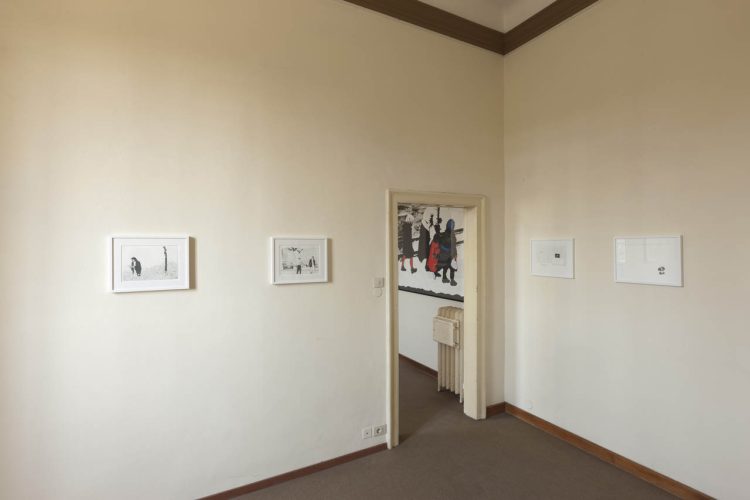
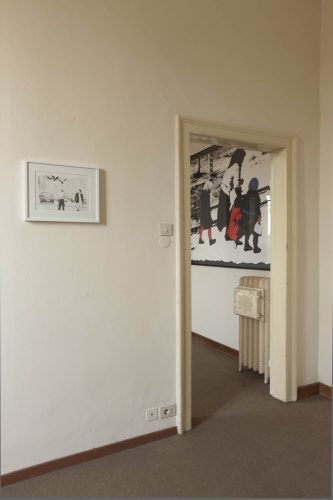
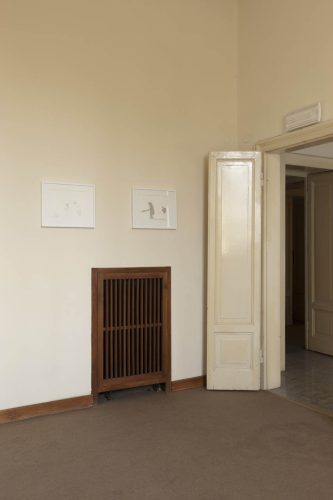
I accomplished this 26 portraits series in two sessions. 22 in 2007 summer, the other 4 in 2009 spring, these last for 2009 fall/winter Kris Van Assche’s advertising campaign (and here i drew myself much more hotter, besides I had to look like a model – pretty tough matter). At the beginning they just should be little reverse “fioretti”, inverting the topic of  Franciscan “fioretti” (one of the first drawings is actually mocking Giotto’s Sermon to the Birds, replacing birds with paper planes), or rather little meaningless – but at the same time – essential miracles: biting a shark in open sea, scaring Count Dracula, drawing the sun in the sky, planting flower books in the ground… But more and more that the work was progressing, I realized that I was dealing, actually, with an handbook, drown in Hokusai’s mangas style: a survival handbook for artists, an interpreting key of reality that allowed me to create a link between the ideas I had and what I wanted to do. So, a lot of these drawings, between 2007 and 2009, became a starting point for a lot of big installations, from Eine Symphonie des Grauens to Robespierre, from The Origin od the species to several collages to arrive to Enciclopaedia of Garden Flowers that is inspired by the drawing where, tearing pages from a botany book, I saw them in the ground, waiting for them to grow. In this exibition, for the first time, these 26 drawings are shown to the audience: I think this is an important viaticum for the exibition. Being disposed in the two room next to the entrance, they discreetly invite the public to enter in touch with my most secret and intimate world, showing all the things that are at the base of my last years work, following Testori’s method, according to wich he used to sorround himself of all the paintings he found of a given artist and, then, understanding the life, the desires and the passions just through his painting, his (de)sign.

Andrea Mastrovito 

L’idea di questi “giardini di libri” mi venne una sera di due anni fa esatti, mentre sistemavo lo studio. Arrivò Zizi, mio amico fraterno, e mi chiese di realizzargli al volo, per forza, una piccola opera per una ragazza che doveva conquistare, una ballerina. Così, dopo una discussione poco ortodossa, per sbrigarmela in poco tempo, decisi di prendere uno dei libri su Degas che avevo sugli scaffali. Lo aprii su una riproduzione di due ballerine e le ritagliai su tre dei quattro lati, tenendole attaccate alla pagina per i piedi. Una volta piegate perpendicolari al foglio, viste di taglio, sembravano davvero danzare sul libro. Zizi prese il volume, lo diede alla ballerina e, potenza dell’arte, oggi convivono in una bella casa vicino al Serio. Di lì alle Enciclopedie dei fiori da giardino il passo era breve: avevo notato la semplicità e l’immediatezza di quel lavoro, ma necessitavo di qualcosa che gli desse forza e verità. E così pensai ai fiori: forza, perché dal fiore nasce il frutto, dal frutto l’albero dall’albero la carta e dalla carta il libro, che nel mio lavoro ritorna fiore, e così il cerchio si chiude vichianamente tornando al punto d’inizio del ciclo; verità perché solitamente le raffigurazioni dei fiori sui manuali sono in scala 1:1, a grandezza reale, quindi verosimili all’occhio. A Casa Testori presento questa aiuola che riprende la forma esatta del trompe l’oeil dipinto sul soffitto soprastante, diventando trompe l’oeil essa stessa. Qui i protagonisti sono i ciclamini, o “pampurzini”, fiori preferiti da Giovanni Testori, citati ripetutamente nel suo Ambleto, e che, dopo un pesante esaurimento nervoso, dipinse in un celebre ciclo di dieci piccole tele che regalò ai suoi familiari, come segno di gratitudine per la vicinanza durante la malattia.


Stanza Precedente                                                                                                  Stanza Successiva 

TORNA ALLA PIANTINA

Gesù di Bergamo nasce nell’estate del 2010, quando i ragazzi di Cantieri d’Arte di Viterbo mi chiedono un progetto per un libro d’artisti a più mani, Drawing a New Memory, in cui ad ogni artista viene chiesto di rileggere il passato reinventandolo. È da tempo che cerco un pretesto per mettere su carta un vecchio progetto, ovvero la stesura di una sceneggiatura per un film sul ritrovamento del corpo di Cristo.
Ricordo bene che già nel 2007 ero andato apposta a Chi vuol esser Milionario per racimolare quei 300-500 mila euro necessari ad avviare la produzione del film, e a dire il vero ce la stavo anche facendo, sparando risposte a caso, quando Gerry Scotti mi fece sbagliare la domanda da 70.000 euro. Maledizione…
Questa l’idea iniziale, poi si sa, quando si comincia a scrivere, come diceva Verga, il romanzo sembra che si scriva da solo. E così è venuto fuori questo Gesù di Bergamo, che per metà è storia vera, per metà è rilettura – compendiata e scanzonata – dei Vangeli, le cui vicende sono riadattate, per l’occasione, invece che in Palestina, nella ridente città di Bergamo, proponendo un modus operandi già caro a Testori il quale riscrisse l’Amleto, il Macbeth e l’Edipo Re riambientandoli nelle terre a lui care della provincia milanese.
La stanza con le 500 copie di Gesù di Bergamo – disponibili, gratuitamente, al pubblico – si pone all’inizio del percorso ideale del primo piano: come noto, la fede religiosa era il principio fondante attorno al quale si formò il nucleo famigliare dei Testori, e da qui parte il piccolo ciclo di cinque stanze ad esso dedicate.

Andrea Mastrovito

L’utilizzo della fotocopia ricorre spesso nel mio lavoro. Dopo aver fotocopiato l’intera galleria Analix Forever nel 2007, l’anno successivo mi ritrovai a New York, all’Italian Academy della Columbia University. Qui avevano questa bellissima (esteticamente) biblioteca, enorme, calda, accogliente: veniva voglia di sdraiarsi sui grandi divani e leggere libri tutto il giorno, non fosse che i volumi erano disposti a caso e mancava un indice, una catalogazione. Questo perché, pare, tutta la grande collezione di libri dell’Italian Academy era stata venduta (credo alla Columbia) ed il Governo Italiano soltanto dopo molti anni aveva pensato bene di inviare decine di scatoloni contenenti migliaia di libri sfusi, dalla letteratura alla storia dell’arte. Disposti lì uno accanto all’altro, i volumi erano sì bellissimi e nuovi (quasi tutti ancora incellophanati), ma praticamente inutilizzabili. Mi colpì molto il concetto di “facciata”, in cui il libro diventa oggetto d’arredamento (il fatto che le librerie dell’Academy fossero vuote, tempo prima, aveva fatto storcere riprovevolmente il naso a parecchi professoroni della Columbia che le osservavano passeggiando per la Amsterdam Avenue), e pertanto decisi di creare io stesso un indice dei libri, semplicemente fotocopiando tutta la biblioteca, pezzo per pezzo, e re-installando le fotocopie sui libri veri. Al contempo, per facilitare la fruizione della nuova libreria fotocopiata, rilegai due differenti copie di tutte le circa 1360 immagini utilizzate in due grossi cataloghi di due volumi l’uno. La metonimia così ottenuta, il contenente per il contenuto (la libreria DENTRO i libri), permetteva al visitatore di sfogliare rapidamente tutte le coste dei libri presenti nella biblioteca e trovare così, con meno difficoltà, il volume desiderato. Da qui l’idea di ri-costruire questa biblioteca “viaggiante” a Casa Testori: i files originali delle immagini sono stati riadattati alle misure della stanza che fungeva da studio per Giovanni Testori e i nipoti, e ne ricoprono le pareti simulando la presenza di libri e scaffali. Il fatto che questa biblioteca sia, per sua natura intrinseca fin dall’inizio, easy come, easy go, la rende particolarmente adatta ai muri di Casa Testori, dove Giovanni era solito tenere la sua vera biblioteca, ovvero i quadri della sua collezione che, una volta studiati e sviscerati, venivano prontamente sostituiti da nuove tele di diversi autori.

Andrea Mastrovito 

Dracula venne realizzato per la prima volta nel 2008 in occasione della mostra Nickelodeon da 1000eventi a Milano: il Dracula di Bram Stoker è uno dei romanzi che hanno avuto più riduzioni cinematografiche, se ne contano circa 650. In quest’opera presento la videoproiezione di otto film basati sulla storia del Conte transilvano (dal Nosferatu di Murnau del 1922 a quello di Herzog del 1978 sino al Bram Stoker’s Dracula di Coppola passando per le versioni Universal di Tod Browning del 1931 e Hammer di Terence Fisher del 1958) effettuata sulle coste delle pagine di circa 60 differenti edizioni del romanzo stesso. Il lavoro, oltre ad enfatizzare le inevitabili differenze d’interpretazione non solo a livello di regia ma persino di traduzione del romanzo stesso, prende piede dalla nozione di “diritto d’autore” a proposito della trasposizione in pellicola di una qualsiasi opera letteraria: Nosferatu infatti fu il primo caso riconosciuto di plagio da parte di un regista nei riguardi di un romanzo. Murnau, pur cambiando il titolo e i nomi dei personaggi riprese esattamente la storia dal libro di Stoker. La vedova dello scrittore fece causa al regista per plagio e vinse obbligando il regista a distruggere il film. Alcune copie si salvarono solo casualmente, permettendoci di poter ammirare ancora oggi questo capolavoro. Il caso creò un precedente giudiziario e da allora il copyright venne esteso anche su eventuali trasposizioni cinematografiche di opere letterarie. Sul soffitto, Dracula viene completata dall’installazione di Chirotteri, circa 200 libri sui pipistrelli, ritagliati e fissati con viti uno accanto all’altro. Questo lavoro chiaramente prende piede dall’opera Enciclopedia dei fiori da giardino e nacque una  notte di ottobre del 2009: ero a New York e stavo realizzando, coi miei assistenti, la nave de Non ci resta che piangere, l’installazione per il Museum of Art and Design. La sera, dopo 12/14 ore di lavoro, spesso passavo da Strand Books, quest’enorme negozio di libri tra la 12th street e la Broadway, dove ogni volta cercavo nuove idee per nuovi lavori, e così mi capitò tra le mani un bellissimo volume esclusivamente sui pipistrelli, roba mai vista in Italia. Subito da lì l’idea di rivestire un intero soffitto con centinaia di libri del genere. Quello fu il nucleo primigenio dell’installazione The Island of Dr. Mastrovito a Governors Island nel 2010, che oltre ai pipistrelli sul soffitto, prevedeva centinaia di libri di farfalle sui muri e volumi su ogni tipo di animale – ritratto a grandezza naturale – sul pavimento. Questa stanza, disposta esattamente dove si trovava una delle biblioteche di Testori, chiude il ciclo delle tre stanze dedicate ai libri, stanze che Testori stesso aveva dedicato allo studio dei libri e delle opere.

 
Torna in alto