Opening:
Saturday, 14 November, from 5:00 pm
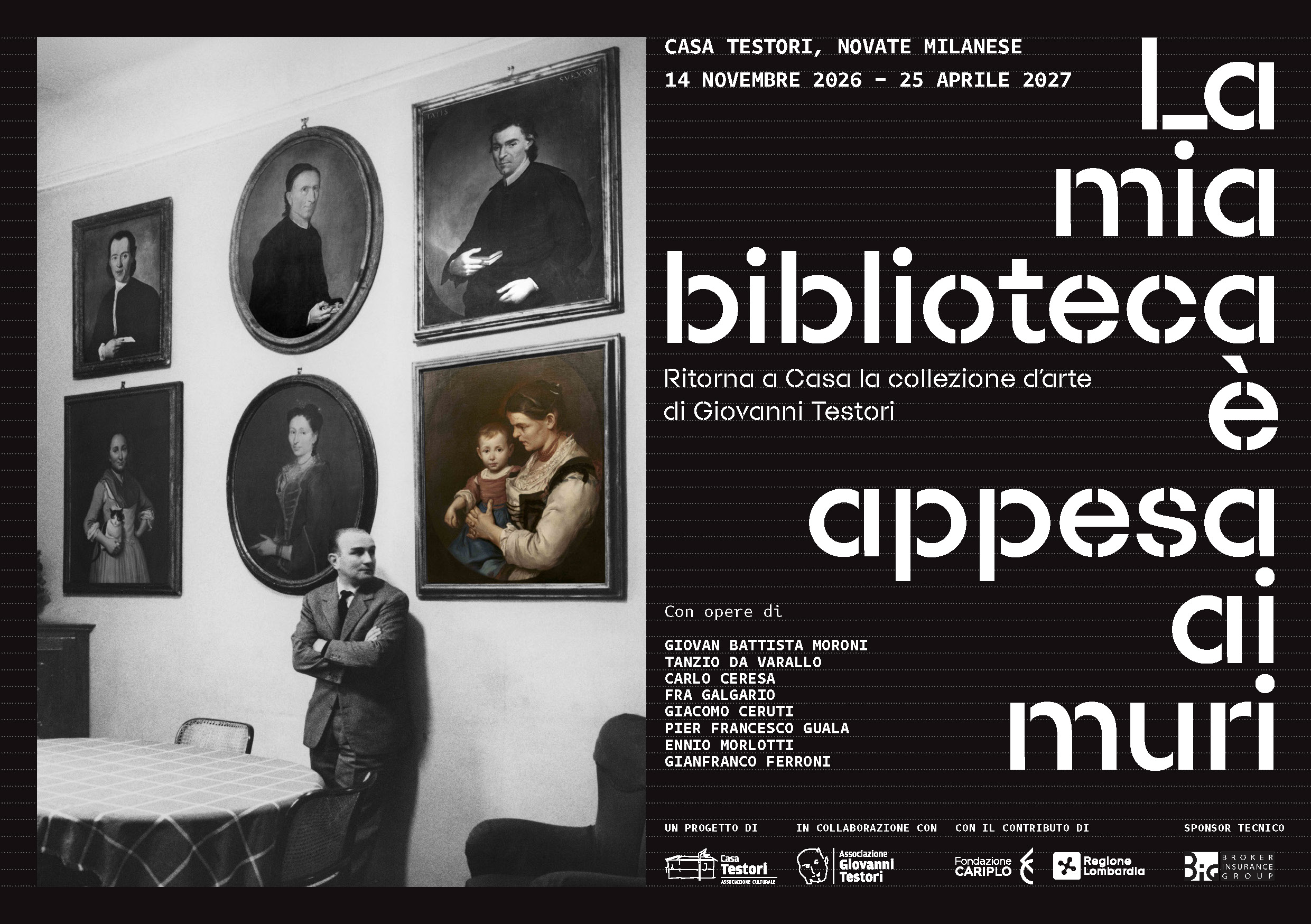
The autumn 2026 exhibition at Casa Testori is a journey back in time to the home of the writer and art critic Giovanni Testori (1923-1993), as it looked in the 1950s and 1960s. Through photographs and exceptional loans of works from private collections, normally hidden from the public, visitors can discover Testori the collector, in the years when works by Tanzio da Varallo, Fra Galgario, Giacomo Ceruti and Ennio Morlotti hung on his walls. These are paintings tied to his discoveries, never exhibited before or resurfacing after decades of oblivion from the rooms of their jealous custodians.
More than four hundred works are documented as having belonged to Testori’s collection, as shown by the research of Davide Dall’Ombra and Chiara Di Palma, the curators of the exhibition, over years of study and refinement. The fruit of his work as an art critic, his collection was a living organism, constantly changing with his passions. The journey spans more than four decades, and the exhibition tells of its extraordinary beginning: from the first work to enter the collection during the War, a tempera by his friend Ennio Morlotti, to the close of two decades expressly devoted to the art of the past, in particular Lombard art of the 17th and 18th centuries, rediscovered alongside his master Roberto Longhi.
It is an immersive path through the rooms of the house as they appeared between 1954 and 1963, before the move, albeit temporary, to Milan. Official portraits and family photographs accompany us on this journey through time, to find a female portrait by Carlo Ceresa and the extraordinary collection of works by Giacomo Ceruti, known as Pitocchetto, one of his greatest critical discoveries. It brought to light masterpieces found on his travels among antique dealers and junk dealers in the provinces, now presented in the exhibition.
Visitors will be able to retrace Testori’s critical activity, from his first essay in “Paragone” on Francesco Cairo (1952) to the exhibition I pittori della realtà in Lombardia of the following year. There, as in his own collection, the extraordinary painting by Giovan Battista Moroni was displayed, one of the most important portraitists of the 16th century, celebrated in recent years by international exhibitions at the Royal Academy in London and the Frick Collection in New York.
The dining room of the house will be the place to meet again the great masterpieces by Giacomo Ceruti and Fra Galgario, restored for the occasion: the unforgettable faces of the humble who, from the 18th century, return today to look at us with all their powerful truth.
To complete the picture of Testori the critic and collector in those years, visitors will find some decisive works that entered his collection to take their place at the center of his essays. Thus Collina a Imbersago, perhaps the largest canvas painted by Ennio Morlotti, will be shown in the main hall, representing a moment when Testori’s militant criticism was devoted almost exclusively to the painter from Lecco, of whom he collected dozens of paintings. Among these, a Paesaggio that won the Premio Nazionale di Pittura Città di Gallarate (1955) and Le calendole, shown at the 28th Venice Biennale (1956), also return home.
One room of the house will be transformed for the occasion into an extraordinary cabinet of drawings, thanks to the exceptional loan of 13 sheets never exhibited before, attributed by Testori to Tanzio da Varallo and his brother Giovanni d’Enrico, the great interpreters of the 17th-century phase of the Sacro Monte of Varallo. It is the heart of his Palinsesto valsesiano (1964), the Scheiwiller volume with which Testori placed drawing, a great passion of his, at the center of the rediscovery of the Sacro Monte, a passion he lived personally not only as a collector but also as an artist. It is a unique group, never exhibited, which has come down to us intact, still in the frames chosen by Testori and restored for the occasion.
In the exhibition, visitors can follow the common thread of Testori’s passion for the artists of the past, also through discoveries on the market and his collaboration with the auction house Finarte. In 1966 came Testori’s exhibition devoted to 32 other unpublished paintings he attributed to Giacomo Ceruti, organized by the Milanese auction house and followed the next year by the exhibition at the Museo Civico in Turin, Giacomo Ceruti e la ritrattistica del suo tempo nell’Italia Settentrionale. This allowed him to fulfill Longhi’s wish to see 18th-century works by Venetian and Lombard artists compared side by side. This “challenge” is now evoked in the exhibition, also thanks to the splendid Ritratto di ecclesiastico by Ceruti, then in his collection, with which he had “challenged” the Venetian painter Alessandro Longhi.
1967 marks, in a way, the watershed at which the ground-floor itinerary closes and the first-floor display begins, passing through a route that, publication after publication, retraces the collecting episodes that led from Morlotti’s Natura morta, the first painting to enter the collection, bought by his father Edoardo while the painter was evacuated to their house in Sormano (1943), to Gianfranco Ferroni’s Lago, acquired in the late 1960s, underscoring the strong presence of contemporary artists alongside the old masters.
The break with the auction house Finarte of Casimiro Porro, which took place precisely in 1967, provides the occasion for a story linked to Testori’s passion for Théodore Géricault, a French artist also fundamental to his poetic production. Testori gathered an important group of unpublished works that he believed to be by the master, followed in print by the critic Antonio Del Guercio, who wished to publish them in his catalogue of the painter. Some male nudes hung in his bedroom, photographed by Giacomo Pozzi Bellini in the early 1960s and transformed into an extraordinary contemporary work by Andrea Mastrovito in 2011. Now, in this room, for the first time, it will be possible to see again in person the key painting of the group: the fascinating and mysterious Trionfo della Miseria, also restored for the occasion. The years and subsequent studies have shown that these were infatuations of love, tracing the works back to anonymous masters of 19th-century France. But the exhibition does not wish to limit itself to presenting Testori’s extraordinary critical successes, and the great painting is displayed as a symbol of his all-round creative impetus, capable of infatuations and errors, as befits anyone’s life. The history of art proceeds, after all, through continual critical adjustments, and masters are able to set an interpretive line that withstands problems of attribution, turning them too into occasions for knowledge and discovery.
A focus on the relationship with his master Roberto Longhi, reconstructed through their dense correspondence recently published and annotated by Davide Dall’Ombra (Feltrinelli, 2026), allows us to piece together the picture of Testori as writer, critic and collector, from the early phases of study and training through his dealings with the master, up to the completion of exhibitions and publications. This relationship forms a true common thread running through the whole exhibition.
GROUP BOOKINGS and GUIDED TOURS:eventi@casatestori.it
