
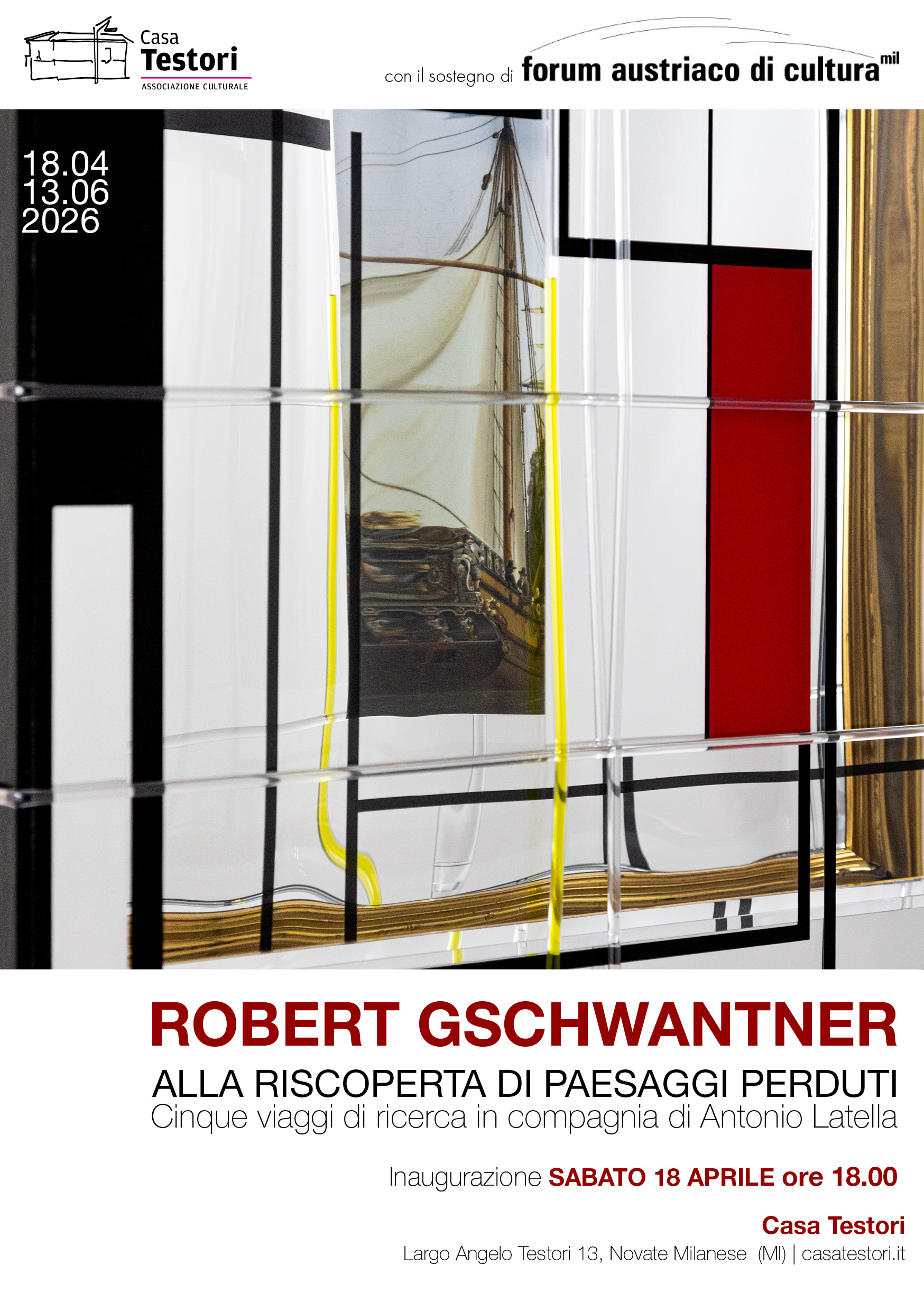
Opening: Saturday, April 18, from 6:00 PM
Austrian artist Robert Gschwantner (Steyr, 1968) has devoted his artistic practice to investigating these sites through research and on-site exploration. This has led to cycles of works that narrate—through sculptural, video, and installation forms—what remains of these often forgotten catastrophic events.
At Casa Testori, in his fourth exhibition in an Italian museum institution, Gschwantner presents works developed after five explorations of locations across Europe that bear the scars of such environmental violence: Las Médulas in Spain; the island of Gyali and Corinth in Greece; the Afsluitdijk in the Netherlands; and Magdeburg in Germany. All of these can be considered “lost landscapes,” having been profoundly altered by pollution or by drastic interventions driven by economic or political motives.
During his fieldwork, the artist collects materials that he later inserts into transparent PVC tubes, which he uses to create tapestries and wall-based works. These pieces take on the character of contemporary reliquaries, incorporating real fragments that testify to the damage inflicted on the natural environment by human activity. Gschwantner’s practice is further supported by documentary research, connecting the works to maps, photographs, and video.
His work offers a rigorous and well-documented reflection on models of development that too often result in irreversible environmental damage. At the same time, the artist seeks to offer a form of restitution—through highly poetic gestures—to landscapes violated by human activity: his works act as displays in which recovered materials are transformed before our eyes. The remnants of disaster are thus presented in contexts of unexpected beauty.
An important aspect of Gschwantner’s work is the ongoing conversation with Antonio Latella, one of Italy’s leading theatre directors and a companion in both travel and poetic reflection on these complex issues that affect us all. The exhibition will thus be accompanied by a publication featuring a conversation between Gschwantner and Latella, edited by Gilberto Santini. This dialogue further explores the themes of the exhibition and guides the visitor through the experience.
As the artist explains: “The idea for this exhibition stems from Testori’s artistic versatility, as he was active in both visual art and theatre—fields in which we respectively work. In seeking a connection between us, we began with the projects in which Antonio Latella was able to accompany me. It is always a great experience when he can join me. This has happened five times out of the twelve projects I have carried out over the years, and these are the ones presented in the exhibition. They are highly representative of my path, as they reflect moments in which my research was shared with him. During one of these journeys, Antonio also began writing his first novel. The trip was a source of inspiration for both of us” (author’s translation).
