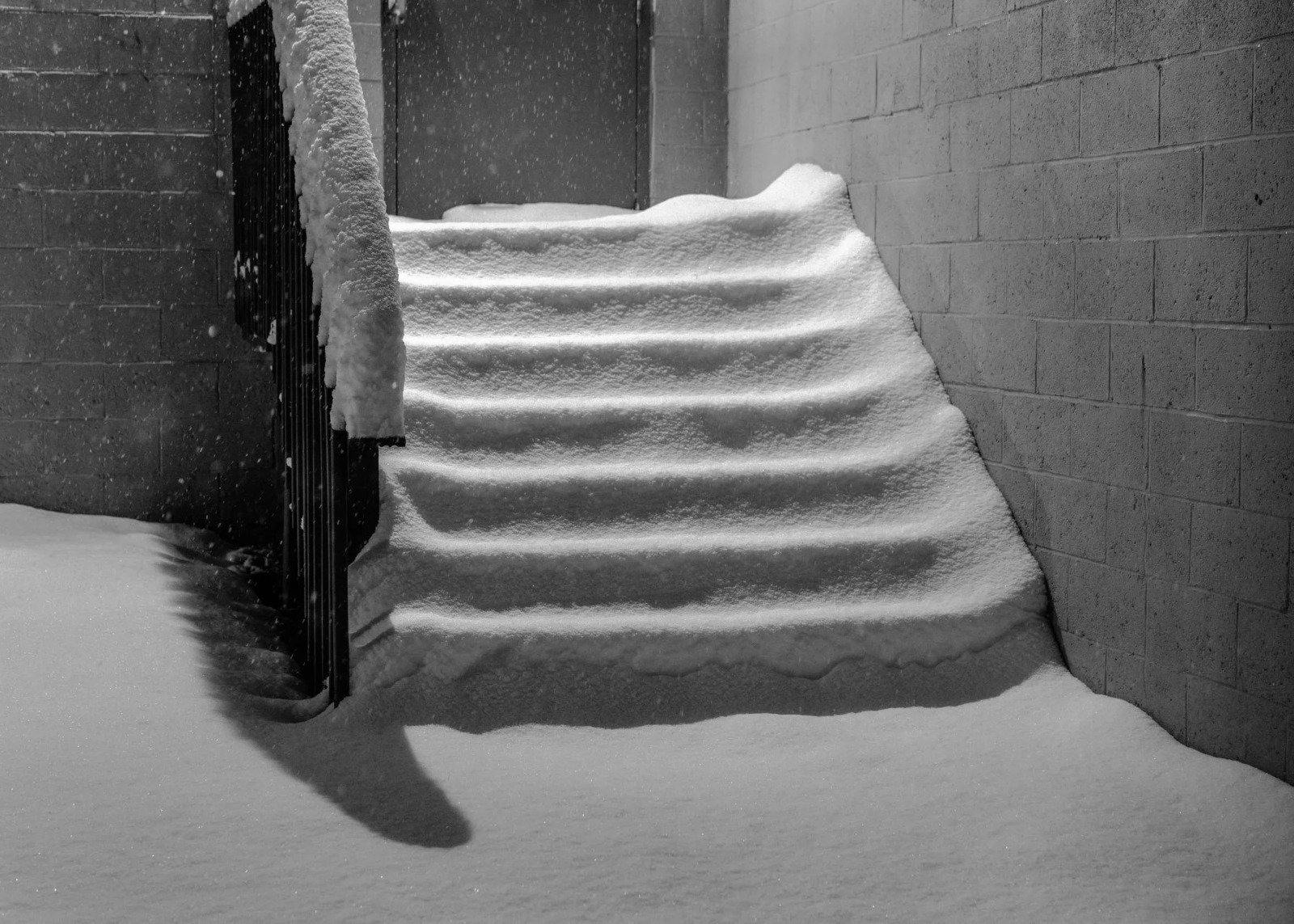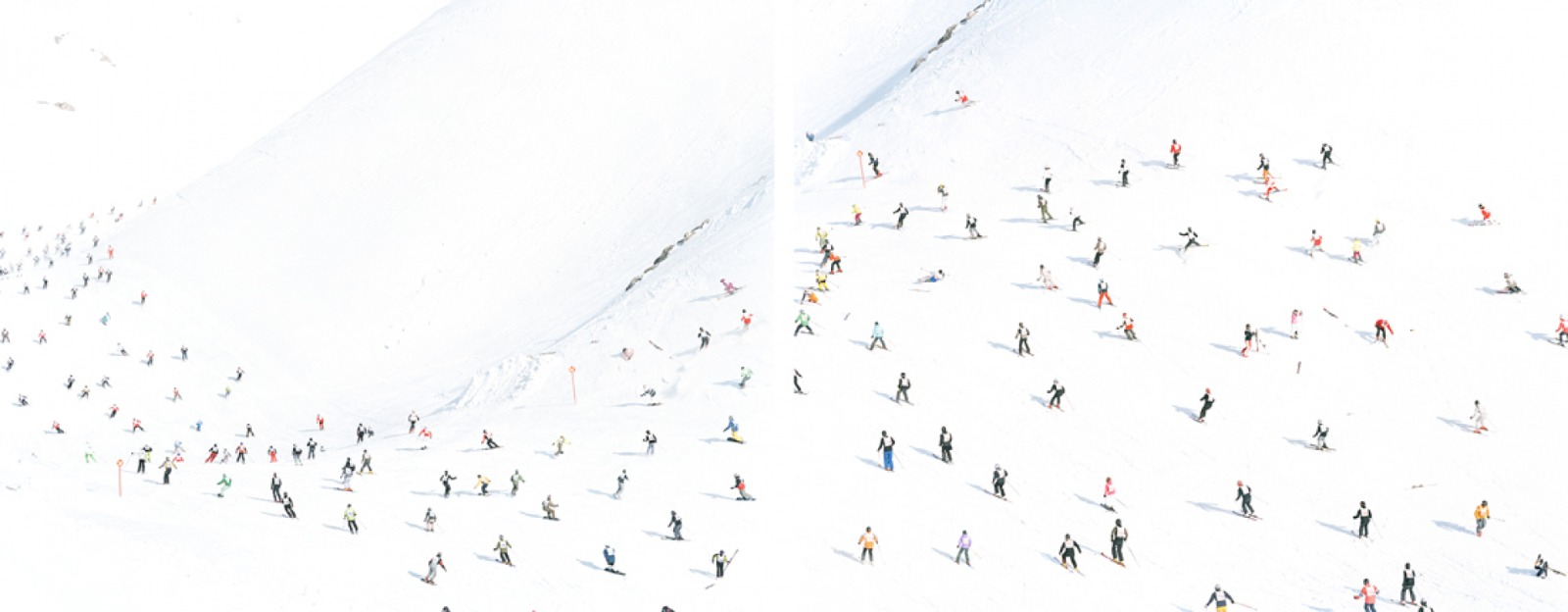
The whiteness of snow has always been a challenge for photographers of every era. Like the darkness of night, it represents a limiting condition in which light is fully reflected and puts the photographic medium to the test. It is also an element that transforms the landscape—both Alpine and urban—altering not only colors but also forms, and revealing changes in the relationship between humans and nature, between the natural environment and anthropized space. Snow is also a powerful metaphor, as James Joyce suggests: “His soul swooned slowly as he heard the snow falling faintly through the universe and faintly falling, like the descent of their last end, upon all the living and the dead.”
Two recent books published by American authors have placed the phenomenon of snow and winter at their center: Winter Nights, Walking by Ed Panar (Fw:Books / Spaces Corners, 2023) and King, Queen, Knave by Gregory Halpern (MACK, 2025). The former is a visual diary of the author’s nighttime walks through his city, Pittsburgh. The latter is the result of a twenty-year body of work carried out in Buffalo, where the alternation of seasons becomes a metaphor for the life cycle, oscillating between death and rebirth.
Two Italian authors as well, Olivo Barbieri and Walter Niedermayr, have worked on the theme of winter and the Alpine landscape. With different approaches, both have critically observed the natural and social phenomena that occur in the mountains, using photography as a tool of investigation that demands slow and in-depth observation.
The program was curated by Luca Fiore for the project NEVEr alone by Casa Testori, realized thanks to the “Cultural Olympiads” open call promoted by the Lombardy Region for the Milan–Cortina 2026 Winter Olympic Games and included in the Cultural Games calendar. NEVEr alone is a multidisciplinary project that rediscovers snow starting from Giovanni Testori’s editorial Benedetta tu, sorella neve (Blessed Are You, Sister Snow), published on January 17, 1985, in Corriere della Sera and written on the occasion of the great, historic snowfall of those days. The editorial served as the spark for the development of two exhibitions. On the ground floor of Casa Testori, a group exhibition of contemporary art curated by Giacomo Pigliapoco, complemented by two project rooms curated by Greta Martina and Rosita Ronzini, in which artists engage with snow in its symbolic and poetic meanings. On the first floor, a focus on the 1985 snowfall, where Testori’s editorial enters into dialogue with the photographs taken during those days by photographer Mario De Biasi (1923–2013).